8
1
8
download/literature/watchtower/1900-19.pdf
watchtower/1900/19/1900-19-1
(288<?91)
ZION'S
WAlCH
TOWER
ALLEGHENY.
PA.
repre~pntatiYe~
of
Israel
\H're
unre~tly
for
the
invitation
was
not
permiitpd
to
hinder.
l,nrl
our
Lord.
through
his
disciples,
suhsequelltly
p,tl'nd('d
tIle
111\
l'tatlOll
to
another
das~.
The
tnal
of
the
natIOn
:'"
a
whole.
representpd
by
its
lead·
er~.
('ndN!
at
Calvary.
or
ratl1Pr
1he
days
before
Calvarv.
when
our
Lord
rodp
on
th'P
a,-,
and
Wl'pt
o\'e~
the
city
of
Jer'usalem,
E'aYlIlg.
"0
.J
pru"a
Ipnl
.
.JPIlhfl
Ipn!.
thou
that
killest
tIl('
prophets
and
~tonp'-t
thpm
that
al
p
sent
unto
th('e'
how
oft
would
I
ha\'('
g.lthp]('(l
tll:,
chil<lrl'lI.
as
a
hcn
g-athereth
her
chickens
undcr
l]('r
\\ln~"
alHl
\'('
\\o111r1
not'
Bphol,l,
vour
h(\ll~e
is
ll'ft
llnto
Y"il
</p,-(\]"t(""
.\'-
a
l',ltlOfI.
as
[l.
ppoplp.
you
havp
rpll'dpd
tli,·
(In
II1P
invltfltion
tf'
tIl('
I!rpat
fl'n~t.
and
as
ana·
tion
Vall
(',(l1l1ot
ta'-tp
of
It,
Np\'prtlH'lp~,-
a('pording
to
(hvine
intclltwlI
,Ill
(1
proml'p
tllrou~h
thl'
prophets.
God
extpnneel
nlPf(',
to
\~trlOll'-
lIldlYidllal,
of
that
natIOn.
aftpr
tIl('
natioll
a,-
fl'
\\
holt,
hflll
prm'pll
it'-elf
unworthv
of
thp
kll1gdoll1
PIIVI'
Je''.!(·,
TIi"
a]""
..
11,·,
\\Crp
'('Ilt
to
i"
tllpr
IHlt
tIll'
natioll.
hut
sllC'h
inelt\](l\l,']'-
;1'-
\\pre'
of
lIlllllLle
min\i.
to
'-hare
in
UH'
f!'a
,-t,
and
t}1I~
('a
lllll~~
of
lJllll'
](]lla
1,-.
lJl~tpa(1
of
thp
nation
of
1
'-l'fll'!
\\;h
1,''-pond,·']
to
\',<
111'-1\
ply
l,y
tho<;p
wh'l
rpah7!'(1
th('lr
0\\
n
llll\\
orl
Jl1n(''-'.-tlll·
hlllip.
thp
llRlt
tIl('
lllind,
who
l'onf(',-,-('d
tl',lt
1]1('\'
\\
('rp
Ilot
Pl']
t('('t.
1I11t
who
ne,in'el
ppr
fpdioll
;lllcl
\\ho
rejoll,11
ill
thp
(';111
to
polrtakp
of
thl'
kin~'·
110m
pri\
ilpg('~
and
!!1,,111v
!(ll'.ook
all
plsf'
for
it.
Amongst
tlH'm
W('
arp
H"nrpd
thprp
arc·
}lot
mflny
WI"P
not
RlRI1V
g-f{'at.
not
1lI""\'
1(""
ned
ll11t
e
hipfl.\'
tl1('
poor
fl'r
Rlthoug-il
thp
pOOl'
an'
not
all\'av~
hl1ml,]('
I,y
an;'
me'lIl".
ypt
Rmong<;t
th('m
proportIllnntpl.\·
morp
\\prp
founel
\\hl'
were
of
Rcceptablp
f'hRI
al'tpr:
Rmong~t
th,·
n,
h
and
the
g-rput
humility
would
apppar
tn
havp
1)('('n
at
all
times
cOlT!'spondingl'y
scarce.
Tlll~
"f'pond
lJlYltation
to
the
poor.
the
hRlt
and
the
blind.
in
thp
strppts
and
lane<;
of
tIl('
l'lt~'.
RR
R
ph,ture
would
be
\
ery
diflkult
to
apprpciatp
in
Ollr
da;'
of
hORpitals
and
Rlms
1101lRP~,
l·te'
..
proYid('11
b;'
Wn{'ra
1
ta
,ation:
Imt
in
the'
(la:vs
of
our
La
Til
it
would
hp
verv
pa'-v
inl1pecl
to
hRve
collected
a
larl!e
l'row(l
of
indil!pnt
an~l
l1lfirm
in
short
ordpr.
It
will
hp
oh"eT\'l'(1
thnt
hoth
of
thp~p
fir~t
calls
belong
to
the'
l'it;,-that
i<;.
lqap1.
th('
nomlllal
kingdom
of
God.
Rut
the
two
palls
faJ1('(l
to
find
th{'
suffil'ient
numbpr
whil'h
God
hall
prpnp~tinat('(l
;,llOulel
con"titutp
the'
kingdom
(']a~~.
He
rould
ind{'ed
h?\'p
indUl'ed
oth!'rs
to
l'ome
in.
but.
on
the
ron
hary.
he
pllrposl'1y
put
the
im'itation
to
th
p
feRst
in
suph
a
form
as
would
rppcl
tho~p
who
were
not
of
the
right
attitude
of
hpRrt-in
Rurh
a
form
a~
would
attrart
Israelites
indeed.
who
felt
and
acknowledged
thl'ir
own
unworthiness,
and
who
w01l1d
he
glad.
on
entering
the
fpaRt.
to
have
on
the
robe
pro
vidpd
for
th('
glKSt~
(~;'mholil'al
of
Christ's
rig-hteouRneRs),
to
f'o\'er
the
filthy
raj!s
of
tllPir
own
imperfertion,
But
now,
hepausp
a
Ruffiripnt
numhrr
waR
not
found
in
IRrael
to
com,
plpte
thp
elect
numhpr.
the
mpssagp
must
be
spnt
outside
thl'
city.
out~ide
of
.TudRism.-to
the
Gentile's;
and
tllllR
the
third
message
wa~,
"Go
;'e
into
the
highwR,Ys
Rnd
who<;o('vpr
you
m('('t.
('omppl
thpm
to
rome
in."
The
word
"pompeI."
howevpr.
/!iYf'~
a
wrong
thought
lwre:
it
~hould
properly
be
rendered,
urg-e.
per~uRdp.
Allll
thus
it
ha
~
hren
thRt
througllOut
the
Gospel
age,
since
thp
bringing
in
to
tIll'
Go~prl
favor
of
as
many
Jf'\V~
as
were
read.\'
for
it,
thl'
mp"~agp
llRS
hppn
tUrJl('d
to
the
Gentiles.
"to
takp
alit
of
tllPm
a
pN'ple
for
(iod'<;
name."
to
partake
of
th('
g-rpat
fp;l;,t
\\ith
the
T!'mnallt
of
l'-1"np1.
A~
the
Apostle
Paul
FRi(1
to
somp
of
thp
.If·W'-
in
hi<;
prparhing:
"It
was
neces
sa
1'.\'
thnt
thp
wonl
of
(ioll
"hollld
first
have
hpcn
spoken
to
you;
but
sfeing
ye
put
it
from
you.
and
Judge
yourselves
unworthy
of
everlaf-ting
life,
10,
we
turn
to
the
Gentiles;
for
;,0
the
Lord
hath
commanded
us."
(Acts
13'46,
47)
They
"howed
themselves
unworthy
of
thi.;;
great
blessing
or
gift,
in
that
they
were
interested
more
in
the
things
that
perish
than
III
the
glorious
promises
of
the
everlasting
future.
The
Apo~tlp
Paul
calls
attention
to
this
fact
in
Rom.
9:
27:
"Though
thp
number
of
tIll'
chil(lrpn
of
Israel
be
flS
the
~and
of
the
seR,
a
remnant
[only]
shall
he
saved."
The
Apostle
fnrtlwr
show~
that
the
call
of
the
Gentiles
to
be
Rharers
III
the
kml!(lom
is
mcrely
the
continuatilJn
of
the
original
call.
and
thRt
we
arc
called
in
to
take
the
placeR
of
those
who
neglected
'-0
grC'at
"alvRtion
aJl(1
privilege.
He
illnstrates
this
hy
the
olive
tree,
saying
that
the
natural
branC'hes
were
brokpn
off
that
we.
who
by
nRture
were
wild,
mlght
he
gmft('d
III
and
hecome
partakers
of
the
root
and
fatness
of
the
olive,-Rom.
11
:
17.
Thi~
third
('all
tc>
the
great
feaRt
of
the
kingdom
hlessings
and
priYilpl!ps
haR
progresspd
throughont
this
Gos]1pl
age.
and
to
our
nnder~tanding'
is
now
nearly
complete-neHrlr
all
the
plRcps
at
the
tablp
haye
l/pen
proyided
with
gUPRt~;
olll'v
a
few
are
vet
vacant:
and
so
soon
as
thpsp
plapes
Hl
('
fillpd.
the
great
fpast
Will
hpg'lIl,
Rnd
we
shRll
indpee1
PIlter
IIlto
tIl!'
joys
of
our
Lord,
and
not
only
be
privileged
to
feast
onrRP1VC's.
but
to
carry
of
its
bountips
and
blessings
to
all
thp
famil
I('~
of
the
earth.
The
same
matters
wlliC'h
hindered
thC'
Jews.
nnder
the
first
call.
from
accepting
thi<;
invitation.
hRYp
hindprC'd
to
a
large
extpnt
also
many
of
the
Gentiles
who
ha
V('
heanl
the
third
call.
It
is
impoRsible
tf;
he
thorough·going
hnsinesR
men,
weRlthy.
influential,
etc
..
Rnd
Rt
the
same
timp
follow
in
the
footsteps
of
Jesus.
giving
all
of
our
hearts.
talpnt<;
find
ener
gies
to
the
Lord
in
Rcceptance
of
his
inYitation
to
this
fpRst.
The
al'reptanl'e
of
the
invitation
to
this
fea"t
mpans
a
dC'ep
interest
in
it,
be;'ond
eyerything
eIRe.
so
thflt
all
other
mat
ters,
whether
110nses
or
lRJl(l~.
father
or
mothrr.
wlfr
or
phil
dren,
~hall
be
spl'ondary
to
the
interpst<;
of
thp
kingdolll.
and
to
our
responRihilitips
to
the
terms
ann
conditlOn~
of
thC'
invi
tation.
Consequently.
what
was
true
resp('dll1g
IsrRPl
has
been
true
as
re~pe('ts
the
Gentiles.
YIZ"
thRt
thp
('RIl
to
tIlE'
kingdom
has
been
generally.
rejpded
h;'
tho~p
who
had
a
pon
Riderable
mpasure
of
this
world's
blpssingR
and
advantages
thoRe
who
are
rich.
either
in
honor
of
men
or
ROC'Ja
I
position
or
talents
or
reputation
or
money,
have
found
it
difficult
to
leave
these
all
to
follow
Jesus
in
the
narrow
wav:
Rnd,
conse
quently.
the
Scriptural
aRsurance
IS.
not
only
that
those
elected
in
the
end
of
the
Jewish
agp
wpre
l'hi('fly
the
poor
and
lowly.
but
that
the
same
has
been
true
amongRt
th('
Gentiles,
and
'is
true
today:
"Not
many
wi~e
mpn
a
ftpr
the
flpsh.
not
many
mighty,
not
many
noble;"
but
chIefly
the
poor
of
this
world,
rich
in
faith.-l
Cor.
I
:26;
James
2:3,
This
does
not
debar
those
who
have
riches
of
anv
kind.
but
really
gives
them
all
the
greater
privilege
and
opportunity;
for
they
have
that
much
greater
talent
which.
if
th('v
will,
they
may
sacrifiee,
and
thus
the
more
fully
demonstrate
their
appreciation
of
the
invitation
and
of
thp
feast,
and
hp
C'orre
spondingly
appreciated
by
the
HORt.
Let
m
all.
like
the
Apostle
Paul,
lay
aside
every
weight,
every
hindranC'e.
every
besetment.
everything
prerious
to
us
of
an
earthly
kind,
that
we
may
run
with
patience
the
race
set
before
us.
in
response
to
this
invitation
to
the
great
feast
of
joint-heirship
with
our
Lord
in
the
kingdom.-Heb.
12:
1,
2;
Rom.
8'
Hj-18;
12:
1.
2.
VO!..
xxr
ALLEGHENY,
PA.,
OCTOBER
1,
1900
VIEWS
FROM
THE
WATCH
TOWER
No,
19
THE
BIBLE
TRIUMPHANT
"E\"idpnC'ps
porroborativ('
of
the
Bible's
truthfulness
ac
cumlllate
Gl'llf'si<;
notes
Kimrod
as
the
founder
of
the
Chaldee
or
BabylonJRn
empilp
before
Abraham's
day.
(Gen.
10:8-12)
Thp'e
anti
oth('r
fpat
urp~
of
the
narrative
have
been
doubted
and
C'on'-J(IC'rpd
mvthiC'al;
hnt
explorations
in
Babylonia
seem
to
C'onfirm
the
Bihl('
)C'l'ord
Rt
every
point.
\\'e
have
alrpady
mentIOned
the
exploration
of
the
ruins
of
ancient
Xlppnr,
onC'p
the
royal
papitfll.
"ommenced
some
years
ago
hy
thp
rppresentatiYes
of
the
LTniverRity
of
Pennsyl
vania.
e.
S,
A.
The
pR"t
vear.
It
~eems.
has
bepn
a
very
fruit
ful
one.
the
ruins
yipl\ling'
to
thC'
searrhers
vaRt
literary
treasUTps,-the
onl'e
NRtional
Lihrarv
of
Chaldea.
The
Bibll'a
give~
the
following
intere~ting
desc~iption
of
the
find:-
"The
most
surpri~ing
featnre
of
the
discovery
is
that
the
perRonR
who
collef'ted
the
tablets
and
placed
them
originally
in
the
pot
was
an
old
priest,
who
lived
previous
to
and
during
the
time
of
Belshazzar,
and
who
was
evidently
a
scientist
of
no
mean
discrimination.
Tile
pot
was,
indeed,
his
archaeological
museum.
not
portentious
in
size,
but
the
first
museum
known
to
man,
and
therefore
more
important
for
the
bearing
it
had
on
thp
history
of
civilization
than
any
of
the
great
museums
in
existenep
today.
Among
the
articles
found
in
it
were
the
following
tablets:
"1.
One
of
Sargon,
which
gives
his
titles.
This
particular
pieC'e
of
baked
clay
may
give
information
concerning
the
doings
of
centuries.
It
was
the
custom
in
those
days
for
each
king
to
inscribe
a
mpmorial
tablpt
not
only
with
an
account
of
his
victories,
but
with
his
pedigree,
Rhowing-
whC're
he
was
born.
who
were
his
anc
stor<;,
tIl('
gon
he
worshiped,
and
in
faC't,
anything
else
thRt
might
serve
to
impress
posterity
with
his
personal
glory.
These
tablehi.
therefore,
reveal
the
names
and
origin
of
many
of
the
writer's
contemporaries,
predecessors,
and,
as
the
accounts
of
the
suceessive
king'l
dovetail
into
one
another,
they
will
all
in
the
end
constitute
an
unbroken
his
tory
of
this
early
civilization.
There
are,
howevpr,
compara-
[2702]
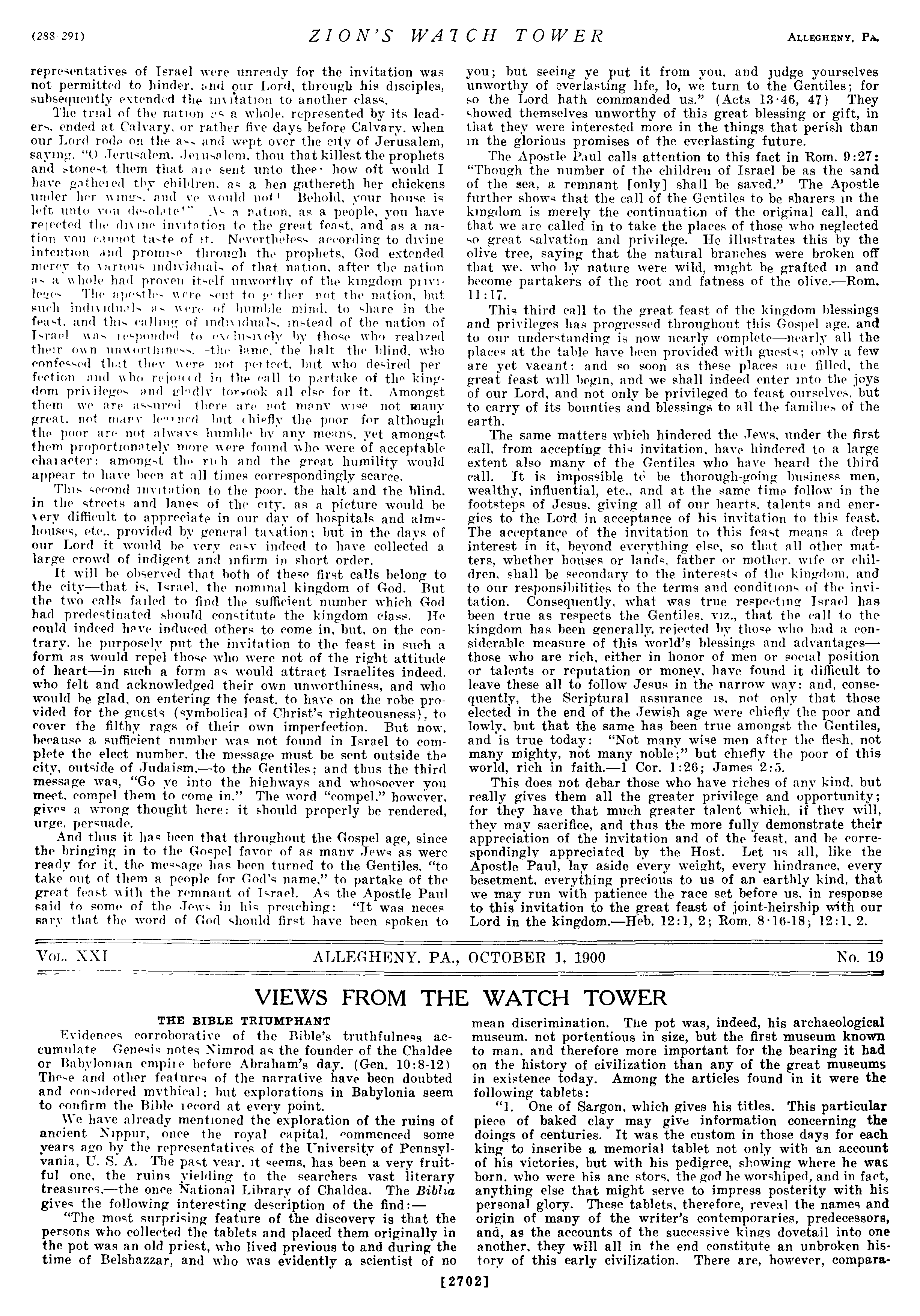
(288-291) representatives of Israel were unready for the invitation was not permitted to hinder. ond our Lord, through his disciples, subsequently extended the invitation to another class, The tral of the nation 2s a whole. represented by its leaders. ended at Calvary, or rather five days before Calvary. when our Lord rode on the as. and wept over the city of Jerusalem, saving, “QO Jerusalem, Jerusalem, thou that killest the prophets and stonest them that aie sent unto thee: how oft would I have gathered thy children, as a hen gathereth her chickens under her wines. and ve would not! Behold, your honse is left unto vou desolate!” As a nation, as a people, vou have rejected the divine invitation te the great feast, and as a nation von cannot taste of it. Nevertheless according to divine intention and promise thronch the prophets, God extended mercy to various individual, of that nation, after the nation as a whole had proven itself unworthy of the kingdom privileges The apestie. were sent to gp: ther prot the nation, but such individuals as were of humble mind. to share in the feast. and this calling of individuals. instead of the nation of Tsracl was responded te exitusnely by those who realized their own unworthiness.—the Jame, the halt the blind, who confessed that they were not pertect. but who desired per fection and who rejoiccd in the call to partake of the kingdom privileges and gledivy torsook all else for it. Amongst them we are assured there are vot manv wise not many great. not mary leerned dnt chiefly the poor fer although the poor are not alwavs humble by any means, vet amonget them proportionately more were found who were of acceptable character: amongst the rch and the great humility would appear to have heen at all times correspondingly scarce. This second invitation to the poor, the halt and the blind, in the streets and lanes of the city, as a picture would be very difficult to appreciate in our dav of hospitals and almshouses, ete.. provided by genera] taxation: but in the dave of our Lord it would be very easy indeed to have collected a large crowd of indigent and infirm in short order. It will he observed that both of these first calls belong to the city—that is, Israel. the nominal kingdom of God. But the two calls failed to find the sufficient number which God had predestinated should constitute the kingdom class. He could indeed have induced others to come in, but, on the contrary, he purposely put the invitation to the feast in such a form as would repel those who were not of the right attitude of heart—in such a form as would attract Israelites indeed. who felt and acknowledged their own unworthiness, and who would he glad, on entering the feast. to have on the robe provided for the guests (symbolical of Christ’s righteousness), to cover the filthy rags of their own imperfection. But now, because a sufficient number was not found in Israel to complete the elect number. the message must be sent outside the city, outside of Judaism.—to the Gentiles; and thus the third message was, “Go ve into the highways and whosoever you meet. compel them to come in.” The word “compel,” however. gives a wrong thought here: it should properly be rendered, urge, persuade, And thus it has been that throughout the Gospel age, since the bringing in to the Gospel favor of as many Jews as were ready for it. the message has heen turned to the Gentiles, “to take ont of them a people for God's name,” to partake of the great feast with the remnant of Israel. As the Apostle Paul said to some of the Jews in his preaching: “It was neces sary that the word of God should first have been spoken to ZION’S WATCH TOWER ALLEGHENY, Pa, you; but seeing ye put it from you, and judge yourselves unworthy of everlasting life, lo, we turn to the Gentiles; for so the Lord hath commanded us.” (Acts 13-46, 47) They showed themselves unworthy of this great blessing or gift, in that they were interested more in the things that perish than in the glorious promises of the everlasting future. The Apostle Paul calls attention to this fact in Rom. 9:27: “Though the number of the children of Israel be as the sand of the sea, a remnant [only] shall be saved.” The Apostle further shows that the call of the Gentiles to be sharers in the kmgdom is merely the continuation of the original call, and that we are called in to take the places of those who neglected so great salvation and privilege. He illustrates this by the olive tree, saying that the natural branches were broken off that we. who by nature were wild, might be grafted in and become partakers of the root and fatness of the olive—Rom. 11:17. This third call to the great feast of the kingdom blessings and privileges has progressed throughout this Gospel age. and to our understanding is now nearly complete—nearly all the places at the table have been provided with guests; only a few are yet vacant: and so soon as these places are filled, the great feast will begin, and we shall indeed enter into the joys of our Lord, and not only be privileged to feast ourselves, but to carry of its bounties and blessings to all the families of the earth. The same matters which hindered the Jews, under the first call, from accepting this invitation, have hindered to a large extent also many of the Gentiles who have heard the third eall. It is impossible te be thorough-going business men, wealthy, influential, ete., and at the same time follow in the footsteps of Jesus, giving all of our hearts, talents and energies to the Lord in acceptance of his invitation to this feast. The acceptance of the invitation to this feast means a deep interest in it, beyond everything else, so that all other matters, whether houses or lands, father or mother. wife or children, shall be secondary to the interests of the kingdom, and to our responsibilities to the terms and conditions of the invitation. Consequently, what was true respecting Israel has been true as respects the Gentiles, viz., that the call to the kingdom has been generally. rejected by those who had a considerable measure of this world’s blessings and advantages— those who are rich, either in honor of men or social position or talents or reputation or money, have found it difficult to leave these all to follow Jesus in the narrow way: and, consequently, the Scriptural assurance 1s, not only that those elected in the end of the Jewish age were chiefly the poor and lowly. but that the same has been true amongst the Gentiles, and is true today: “Not many wise men after the flesh, not many mighty, not many noble;” but chiefly the poor of this world, rich in faith—I Cor. 1:26; James 2:5. This does not debar those who have riches of any kind, but really gives them all the greater privilege and opportunity; for they have that much greater talent which. if thev will, they may sacrifice, and thus the more fully demonstrate their appreciation of the invitation and of the feast, and be correspondingly appreciated by the Host. Let us all, like the Apostle Paul, lav aside every weight, every hindrance, every besetment, everything precious to us of an earthly kind, that we may run with patience the race set before us, in response to this invitation to the great feast of joint-heirship with our Lord in the kingdom.—Heb. 12:1, 2; Rom. 8-16-18, 12:1, 2. Vou. XXI ALLEGHENY, PA., VIEWS FROM THE WATCH TOWER THE BIBLE TRIUMPHANT Evidences corroborative of the Rible’s truthfulness accumulate Genesis notes Nimrod as the founder of the Chaldee or Babylonian empire before Abraham’s day. (Gen. 10:8-12) These and other features of the narrative have been doubted and considered mvthical; hut explorations in Babylonia seem to confirm the Bible 1ecord at every point. We have already mentioned the exploration of the ruins of ancient Nippur, once the royal capital, commenced some years ago hy the representatives of the University of Pennsylvania, U.S. A. The past vear. it seems, has been a very fruitful one, the ruins vielding to the searchers vast literary treasures.—the once National Library of Chaldea. The Bibha gives the following interesting description of the find: — “The most surprising feature of the discovery is that the persons who collected the tablets and placed them originally in the pot was an old priest, who lived previous to and during the time of Belshazzar, and who was evidently a scientist of no OCTOBER 1, 1900 No. 19 ——3 mean discrimination. The pot was, indeed, his archaeological museum, not portentious in size, but the first museum known to man, and therefore more important for the bearing it had on the history of civilization than any of the great museums in existence today. Among the articles found in it were the following tablets: “1, One of Sargon, which gives his titles. This particular piece of baked clay may give information concerning the doings of centuries. It was the custom in those days for each king to inscribe a memorial tablet not only with an account of his victories, but with his pedigree, showing where he was born, who were his anc stors, the god he worshiped, and in fact, anything else that might serve to impress posterity with his personal glory. These tablets, therefore, reveal the names and origin of many of the writer’s contemporaries, predecessors, and, as the accounts of the successive kings dovetail into one another, they will all in the end constitute an unbroken history of this early civilization. There are, however, compara [2702]
To enhance your experience on our website, we use cookies and similar technologies. Some cookies are essential for the core functionality of our site and cannot be declined. You can choose to accept or decline additional cookies. We want to assure you that none of this data will be sold or used for marketing purposes. You can adjust your preferences at any time by accessing the Privacy Settings from the footer of the page. For more information, please refer to our
Privacy Policy
Terms of Use
.


