9
1
9
download/literature/watchtower/1911-22.pdf
watchtower/1911/22/1911-22-1
NOVEMBER
I,
1911
THE
WATCH
TOWER
the
bolly
of
the
"more
than
conquerors."
These
will
ulti
mately
come
off
conquerors
and
attain
the
plane
of
spirit
being
to
which
they
were
begotten
at
the
time
of
their
con
secration.
These
will
be
the
"virgin
companions"
of
the
brille,
serving
in
the
temple.
(c)
A
thinl
class,
described
by
St.
Paul
as
falling
away
and
counting
the
blood
of
the
covenant
wherewith
they
were
sanctified
an
orllinary
thing
and
despising
the
great
favor
and
-privilege
of
sanctification
through
justification.
'l'hese
are
described
also
by
St.
Peter
as
"the
sow
returned
to
her
wallowing
in
the
mire'
'-as
turned
from
spiritual
hopes
anll
promises
to
earthly.
These,
once
counted
mem
bers
of
the
body
of
Christ,
will
die
the
second
death,
as
brute
beasts.
GIFTS
AND
SACRIFICES
FOR
SIN
Question.-What
is
signified
by
the
words
of
the
Apostle
that
our
Lorll
was
ordained
to
offer
both
gifts
and
sacrifices
far
sin
I
Answer.-From
the
Scriptur('s
it
is
evident
that
during
the
.Millennial
age
the
worlll
of
mankind
will
be
privileged
10
offer
thpmselves
to
Goll
as
gifts,
but
not
as
sacrifices.
Hence,
lluring
the
:'.Iil1ennial
age,
part
of
the
work
of
the
great
High
Priest
will
be
to
accept
these
gifts
and
to
make
them
:Icceptable
to
God
through
his
own
merit
and
rights
as
1he
}leJchizedek
Priest.
VIe
can,
however,
apply
this
text
\'l'ry
properly
to
the
present
time.
The
Apostle
puts
the
wont
gifts
first.
\Ve
may,
therefore,
look
to
see
whether
thpre
is
not
some
way
in
which
the
High
Priest
offers
gifts
nnw.
Surp]v
ollr
Lord's
consecration
of
his
own
life
was
a
g'ift
on
llis
pnrt.
'rhe
Father
accepted
that
gift
and
Illtillintely
permitted
our
Lord's
gift
to
constitute
a
sin
offering'
for
others.
Likev;ise,
throughout
thi<>
Gospel
age,
the"
brethren"
are
invitell
to
present
their
bodies
living
~acri!lees-to
give
themselves
to
GOll.-Rom.
12:
1,
2.
WIH'n
we
thus
make
a
present
of
ourselves
to
Goll,
we
a
re
not
ma.king
a
sin-offering
to
God;
for
this
we
could
not
do.
Rut
the
<livine
arrangement
for
accepting
our
gift
i.s
that
each
gift
will
be
acceptable
through
the
merit
of
Christ;
and
that
then,
later
on,
these
gifts
will,
according
to
tha
same
divine
arrangement,
constitute
the
great
sin-offering
which
the
High
Pri('st
gives
for
the
world.
Thus
the
High
Priest
is
ordained
to
make
the
ultimate
offering
of
that
gift
as
the
sin-offering
for
the
world.
Amongst
tho:se
who
served
in
the
offi
ce
of
typical
high
pdest,
says
the
Apostle,
the
uniform
custom
was
that
they
should
offer
both
gifts
and
sacrifices
to
Gu<1.
Hence,
he
proceeds
to
point
out
that
.Jesus,
as
the
Antitype
of
those
priests,
must
haye
something
to
offer.
He
also
must
offer
both
gifts
and
sacrifices,
in
order
to
fulfil
his
priesthood.
He
presented
himself
without
spot
unto
Go<1;
and,
by
virtue
of
that
presentation,
he
is
a
sin-offering
unto
Go<1;
and,
through
his
merit,
he
makes
the
saIlle
true
of
IllS
church,
who
voluntarily
give
theIllSelyes
to
God.
SHOWS
HOW
MERIT
OF
RANSOM
IS
APPLIED
Question.-Is
there
anything
connectell
with
the
Atonf'
ment
Day
sacrific('s
which
corresponds
to
the
ransom
I
1£
so,
what?
Answer.-The
word
ransom
woul,l
mor('
properly
be
rendered
ransom-price,
corresponlling
price.
On
the
Day
of
Atonf'ment
no
type
of
the
ransom-price
is
giyen
us,
but
rather
a
type
of
the
sin-offering,
showing
particular!;'
how
that
ransom-price
will
be
mal]e
applicab'e.
1£
we
scrutinize
this
/l.tOlll'ment
day
type,
howC'vel',
w('
shall
fin,]
t.hat
which
points
to
the
ransom,
in
the
killing
of
the
bullock;
for
the
whole
matter
depended
upon
the
killing
of
the
bnllock.
The
goat
('oulJ
not.
he
killed
first.
The
hul'ol'k
mu~t
first
be
killed
and
the
blood
applied
in
the
Most
Holy
before
any
thing
coul<1
be
llone
with
the
goat.
Hence,
all
that
was
done,
not
only
with
the
Lor,]
's
goat,
but
also
with
the
scapegoat,
was
base,]
on
the
Jeath
of
the
bullock.
So
Jf
we
look
for
anything
that.
might
corresponJ
to
tIle
ram:om-price
in
the
,lay
of
atonement
sacrifices,
we
.shall
see
that
the
death
of
the
goat
was
not
necessary,
but
all
dependeJ
on
the
bullock.
O!
TO
BE
WILLING!
Oli!
to
b('
willing.
willing,
Thy
will
to
110
<lay
hy
flay,
Ohf',]if'llt,
humble
an,1
loving-
o
help
me,
dear
Savior,
I
pra;-.
Willing'
that
thou
mightest
us('
m(',
As
forth
with
g
la,!
tiding'l
I
go,
Thllt
all
who
are
hung'ring
anll
thirsting
GoJ's
mystery
now
may
know.
Oh!
to
be
willing,
wi1ling,
.1
ust
to
be
lell
by
thv
hanil;
"A
messenger
at
t'he
gal
eway,
Only
wiliting
for
thy
cornman,!;
"
Filled
with
thv
suirit
and
rC'ul]Y
The
me~sage
to
C
tell
at
thy
\\:ill;
,.
Willing
shoulr]st
thou
not
require
me,
In
silence
to
wait
on
thee
still."
Oh!
to
be
willing,
willing,
Whate
'er
the
task
may
be,
To
<10
it
as
thou
didst,
dear
Jesus,
That
the
world
thy
spirit
may
see.
Rather
be
willing,
willing,
That
Jehovah
on
earth
be
praised,
To
.surrender
all
earthly
blessings
And
walk
the
appointed
ways.
Oh!
to
be
willing,
willing,
Each
step
to
salvation
to
tnke,
To
suffer
with
thee
in
"the
Holy,"
And
gladly
all
sacrifice
make.
To
walk
in
the
way
with
rejoicing,
~ry
lamp
trimmefl
anrl
well
fillf'l]
with
oil.
Anrl
I'll
soon
hear
the
voice
of
the
Bri,legroom
Saying,
"
Enter
an<l
cease
from
thy
toi
I.
"
DR.
AGNES
HAVILAND.
BROOKLYN,
N.
Y.,
~\'OVEMBER
15,
1911
"IS
MANKIND
ADVANCING?"
[FROM
CURRENT
LITERATURE.]
No.
22
-----
"Tn
;1
hoo],
of
the
abo\"<'
title
"!III'S.
John
:Martin
admin
i"tf'rs
a
51
iff
l'C'huke
to
thf'
pri'le
and
self-confiilence
of
our
ngf'.
Rhe
feels,
amI
she
argues
with
great
skill,
that
human
it;,
iR
not
:lllYaneing
in
any
real
sense.
'The
wor]rl
to,la;'.'
sllf'
remarks.
'is
convincf'll
that
it
i.,
making
rapirl
progl'l'ss.
Iu
",estf'rll
Eur0l'f'
nlul
in
AmE'rica
increas('l!
w('alth
pro<1uc
tion,
,l
....
moeratie
institutions,
free
education,
frE'e
thought,
ihf'
opf'ning
of
opportunltips
in
new
countries,
the
aCl'elf'ra
tiou
of
travl'!
ani!
('omnllmil'utiou,
have
combiu('d
to
prodllp,e
upon
our
generation
an
exhilarating
sense
of
f'xpunsion,
of
liberation,
of
growing
power.'
But
this
impression,
it
seems,
is
an
lllusion.
We
have
not
really
progressed.
Mrs.
Martin
]lk('ns
moilern
civili7:ation
to
a
runaway
locomotive
going
at
trE'm
....
noous
speed
on
a
wrong
track.
'We
have
lost
our
way,'
shf'
says;
aIlll
ad(l.~:
'~{an
may
have
rispn
from
thE'
ap(';
a
Iso
thp
app
may
bf'
a
r!egpnC'ra
j
e
man.
}{eu
are
hf'adp,l
app-wa\'(l
quite
as
frequ('ntly
as
augl·l-war,l.
Time
ruus
nil
plevator
which
goes
hoth
wa:l's.
do\\u
a~
we:!
;~s
up.'
"
'What
is
l,rogrpss'?'
aRk~
Mrs.
Martin
at
the
Olltsl't
(If
her
argumf'nt.
She
rC'plieR:
'The
won!
progrf'ss
slllnJld,
J
believe,
bp
pXl'lusiv('ly
u~pil
10
f'X!HPSS
a
rise
in
human
('apacity,
thp
<levelopll1pnt
of
!Jigh('l'
Ol,ll'rs
of
hUlTlnn
hpings.
Thus
r('stricted,
it
remains,
as
it
should,
a
strictly
qualitative,
never
a
quantitative,
term.
Improved
conditious
conl]uee
to
progress,
and
are
necessary
to
progress,
hut
may
exiRt
win,
out.
prollllcing
progress.
Progress
is
something
more
than
imprO\'emellt.
Progress
means
movement
forwarJ.'
This
definition
leads
on
t.o
a
wonderful
pidure:
"
'Looking
back
along
the
linE'
of
history,
w('
cau
see
that
we
(mankinJ)
have
been
traveling
a
long,
long
roal]
whose
winding
way,
rising
and
falling
('entm;'
aft("·
f·<'ntur;',
we
can
trace
back
for
a
few
thousanil
veal'S
unt.il
it
ent('rs
a
trackless
desert
and
fades
utterly
from'
our
view
in
the
mists
of
antiquity.
Immediately
behind
the
spot
where
we
now
stand
there
seems
to
lie
a
downward
slope;
that
is
to
say,
we
seem
to
have
been
ascending
since
the
C'ighteenth,
the
~f'venteenth,
y('s,
part
of
th"
si:dE'pnth
cpntllriE's.
But
th"
Elizabelhan
era
and
thE'
perio<1
of
the
Hpnai~san,'p
in
ltal~'
do
not
lie
below
us.
Life
was
vpry
full
and
sph'ndid
thPIl;
man
had
climbed
to
a
higher
point
of
outlook
than
that
UpOIl
which
WE'
now
act
out
our
little
ilav.
Behind
those
centuries
the
way
bf~comes
obs('ul'
....
;
it
Sf'PlTls'
to
pass
tlJl'ough
{le"Il
an,l
[4915]
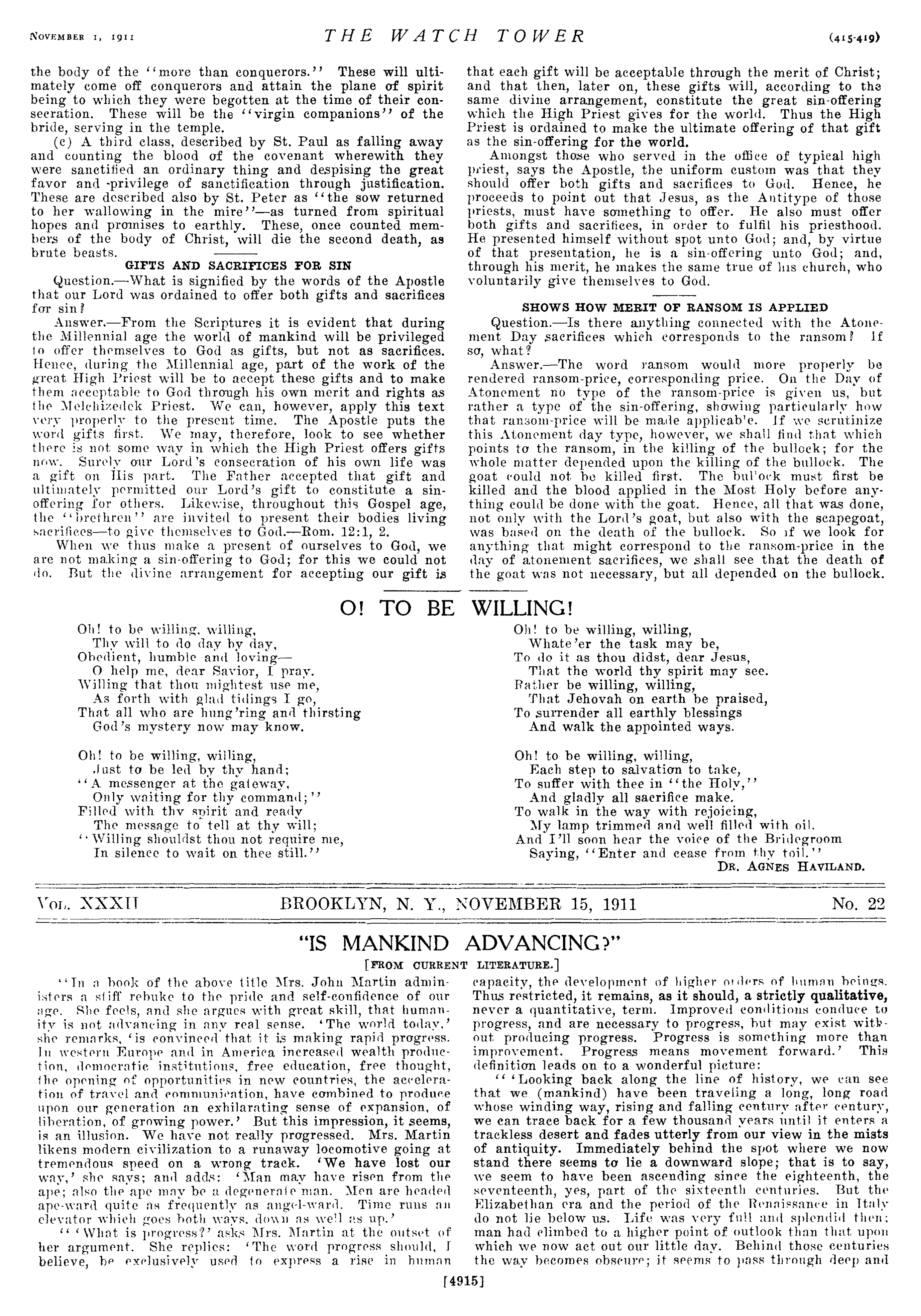
NOVEMBER 1, IQI1 the body of the ‘‘more than conquerors.’’ These will ultimately come off conquerors and attain the plane of spirit being to which they were begotten at the time of their consecration. These will be the ‘‘virgin companions’’ of the bride, serving in the temple. (c) A third class, described by St. Paul as falling away and counting the blood of the covenant wherewith they were sanctified an ordinary thing and despising the great favor and -privilege of sanctification through justification. These are described also by St. Peter as ‘‘the sow returned to her wallowing in the mire’’—as turned from spiritual hopes and promises to earthly. These, once counted members of the body of Christ, will die the second death, as brute beasts. GIFTS AND SACRIFICES FOR SIN Question.—-What is signified by the words of the Apostle that our Lord was ordained to offer both gifts and sacrifices for sin? Answer.—From the Scriptures it is evident that during the Millennial age the world of mankind will be privileged to offer themselves to God as gifts, but not as sacrifices. Hence, during the Millennial age, part of the work of the great High Priest will be to accept these gifts and to make them aceeptable to God through his own merit and rights as the Melchizedck Priest. We can, however, apply this text very properly to the present time. The Apostie puts the word gifts first. We may, therefore, look to see whether there is not some way in which the High Priest offers gifts now. Surely our Lord’s consecration of his own life was a gift on His part. The Father accepted that gift and ultimately permitted our Lord’s gift to constitute a sinoffering for others. Likewise, throughout this Gospel age, the ‘‘brethren’’ are invited to present their bodies living sacrifiees—to give themselves to God.—Rom. 12:1, 2. When we thus make a present of ourselves to God, we are not making a sin-offering to God; for this we could not do. But the divine arrangement for accepting our gift is O! Oh! to be willing, willing, Thy will to do day by day, Obedient, humbie and loving— O help me, dear Savior, I pray. Willing that thou mightest use me, As forth with glad tidings I go, That all who are hung’ring and thirsting God’s mystery now may know. Oh! to be willing, willing, Just to be led by thy hand; ‘A messenger at the gaieway, Only waiting for thy command; ’’ Filled with thv snirit and ready The message to tell at thy will; ‘Willing shouldst thou not require me, In silence to wait on thee still.”’ BROOKLYN, N. Y., NOVEMBER 15, 1911 Vou. XAATT “IS MANKIND ADVANCING?” THE WATCH TOWER TO BE (415-419) that each gift will be acceptable through the merit of Christ; and that then, later on, these gifts will, according to the same divine arrangement, constitute the great sin-offering which the High Priest gives for the world. Thus the High Priest is ordained to make the ultimate offering of that gift as the sin-offering for the world. Amongst those who served in the office of typical high priest, says the Apostle, the uniform custom was that they should offer both gifts and sacrifices to God. Hence, he proceeds to point out that Jesus, as the Antitype of those priests, must have something to offer. He also must offer both gifts and sacrifices, in order to fulfil his priesthood. He presented himself without spot unto God; and, by virtue of that presentation, he is a sin-offering unto God; and, through his merit, he makes the same true of lus church, who voluntarily give themselves to God. SHOWS HOW MERIT OF RANSOM IS APPLIED Question.—Is there anything connected with the Atonement Day sacrifices which corresponds to the ransom? If so, what? Answer.—The word ransom would more properly be rendered ransom-price, corresponding price. On the Day of Atonement no type of the ransom-price is given us, but rather a type of the sin-offering, showing particularly how that ransom-price will be made applicab'e. If we serutinize this Atonement day type, however, we shall find that which points to the ransom, in the killing of the bullock; for the whole matter depended upon the killing of the bullock. The goat could not be killed first. The bul’ock must first be killed and the blood applied in the Most Holy before anything could be done with the goat. Hence, all that was done, not only with the Lord’s goat, but also with the scapegoat, was based on the death of the bullock. So if we look for anything that might correspond to the ransom-price in the day of atonement sacrifices, we shall see that the death of the goat was not necessary, but all depended on the bullock. WILLING! Oh! to be willing, willing, Whate’er the task may be, To do it as thou didst, dear Jesus, hat the world thy spirit may see. Rather be willing, willing, That Jehovah on earth be praised, To surrender all earthly blessings And walk the appointed ways. Oh! to be willing, willing, Each step to salvation to take, To suffer with thee in ‘‘the Holy,’’ And gladly all sacrifice make. To walk in the way with rejoicing, My lamp trimmed and well filled with oil. And I’ll soon hear the voice of the Bridegroom Saying, ‘‘Enter and cease from thy toil.’? Dr. AGNES HAVILAND. No. 22 [FROM CURRENT LITERATURE. | “*TIn a book of the above title Mrs. John Martin administers a stiff rebuke to the pride and self-confidence of our age. She fects, and she argues with great skill, that humanitv is not advancing in anv real sense. ‘The world today,’ she remarks, ‘is econvineed that it is making rapid progress. In western Europe and in America inereased wealth produetion, democratic institutions, free education, free thought, the opening of opportunities in new countries, the acceleration of travel and communication, have combined to produce upon our generation an exhilarating sense of expansion, of liberation, of growing power.’ But this impression, it seems, is an illusion. We have not really progressed. Mrs. Martin likens modern civilization to a runaway locomotive going at tremendous speed on a wrong track. ‘We have lost our way,’ she savs; and adds: ‘Man may have risen from the ape; also the ape may be a degenerate man. Men are headed ape-ward quite as frequently as angcl-ward, Time runs an elevator whieh goes hoth wavs. down as well as up.’ ‘* «What is progress?’ asks Mrs. Martin at the outset of her argument. She replics: ‘The word progress should, I believe, be exclusively used to express a rise in human capacity, the development of higher orders of human beings. Thus restricted, it remains, as it should, a strictly qualitative, never a quantitative, term. Improved conditions conduce to progress, and are necessary to progress, hut may exist without producing progress. Progress is something more than improvement. Progress means movement forward.’ This definition leads on to a wonderful picture: “¢ ‘Tooking back along the line of history, we can see that we (mankind) have been traveling a long, long road whose winding way, rising and falling century after century, we can trace back for a few thousand vears until if enters a trackless desert and fades utterly from our view in the mists of antiquity. Immediately behind the spot where we now stand there seems to lie a downward slope; that is to say, we seem to have been ascending since the eighteenth, the seventeenth, yes, part of the sixteenth centuries. But the Elizabethan cra and the period of the Renaissance in Italy do not lie below us. Life was very full and splendid then, man had climbed to a higher point of outlook than that upon which we now act out our little day. Behind those centuries the way becomes obscure; it seems to pass through deep and [4915]
To enhance your experience on our website, we use cookies and similar technologies. Some cookies are essential for the core functionality of our site and cannot be declined. You can choose to accept or decline additional cookies. We want to assure you that none of this data will be sold or used for marketing purposes. You can adjust your preferences at any time by accessing the Privacy Settings from the footer of the page. For more information, please refer to our
Privacy Policy
Terms of Use
.


