8
1
8
download/literature/watchtower/1914-2.pdf
watchtower/1914/2/1914-2-1
=====================.==========-~-=----
VOL.
XXXV
BROOKLYN,
N.
Y.,
JANUARY
15,
1914
A
PROPHECY
NEARING
FULFILMENT
No.2
"Although
the
fig
tree
shall
not
blossom,
neither
shall
fruit
be
in
the
vines;
the
labor
of
the
olive
shall
fail,
and
the
fields
shall
yield
no
meat;
the
flock
shall
be
cut
off
from
the
fold,
and
there
shall
be
no
herd
in
the
stalls;
yet
will
I
rejoice
in
the
Lord,
I
will
joy
in
the
God
of
my
salvation."~Hab.
3:17,18.
Habakkuk's
entire
prayer,
recorded
in
this
chapter
of
his
represents
how
mankind
will
make
a
full
consecration
of
them-
prophecy,
is
so
symbolical
that
it
would
be
scarcely
in
keep-
sehes,
their
perfect
powers.
ing
with
it
for
us
to
give
the
words
of
our
text
the
plain,
We
know
nothing
better
in
the
application
of
the
bullock
simple
interpretation
that
we
would
he
otherwise
inclined
to
than
that
suggested
by
the
Psalmist.
At
the
close
of
this
give.
This
simple
interpretation
would
be
that
although
the
Gospel
age,
when
all
the
church
shall
have
passed
beyond
conditions
were
such
that
famine
stalked
everywhere,
and
the
vail,
there
will
be
no
perfect
men.
In
other
words,
there
there
was
nothing
of
earthly
hope,
nevertheless
God's
people
will
be
a
point
of
time
when
the
church
will
be
glorified
and
at
any
time
and
in
any
place
would
rejoice
in
God
and
give
"'hen
the
ancient
worthies
will
not
yet
have
appearc>d.
'fhe
him
the
glory.
people
will
stand
amazed,
not
seeing
any
way
out
of
their
It
wouIc1
seem
very
strange,
however,
if
the
Prophet
should
troubles.
Only
those
who
have
the
lig'lt
of
the
Lord's
\Vord
wind
up
the
whole
chapter,
so
highly
symholical,
with
any-
will
be
able
to
appreciate
the
condition
at
all.
thing
so
plain
ani!
literal
as
we
have
suggested.
\Vith
so
Those
who
will
then
understand~the
great
company-will
much
imagery
in
his
mind,
it
would
seem
but
reasonable
that
rejoice
in
the
Lord.
They
will
be
able
to
trust
in
God,
even
th8
words
should
he
interpreted
in
keeping
with
their
con-
thoug'h
conditions
in
the
world
are
distressing,
and
the
ancient
text,
and
that
we
should
regard
it
as
the
Prophet's
expression
'1'orthies
not
yet
here
to
take
hold
of
matters.
They
will
sec
of
some
deep
truths.
Much
of
the
language
of
the
Bible
is
that
the
eonditions
are
really
leading
up
to
the
great
blessing-
figurati"e;
an(1
in
our
common
conversation
we
also
use
many
that
the
great
time
of
trouhle
is
the
necessary
preparation
for
figures.
For
instance,
in
the
Scriptures
a
vine
is
a
figure
hlessing-.
And
they
will
say,
Let
us
rejoice
and
give
glory
to
used
for
the
church:
As
our
Lord
said,
"I
am
the
vine;
the
Lord,
for
the
hride
hnth
maoe
herself
readv!
We
see
ill
ye
arc
the
branches.
"-J
ohn
15:
5.
this
glorification
of
the
church
the
beginning
of
the
great
bless-
The
flock
of
God-the
sheep~are
common
figurative
ex-
ing.
Soon
we
may
expert
to
sce
the
ancient
worthies
here.
pressions
for
the
same
class.
Ol1r
Lord
speaks
of
the
little
Then
will
come
the
fulfilment
of
all
God's
graeious
promises.
flock.
\Ve
arc
his
sheep.
The
Jews
W8re
also
referrea
to
as
So
we
will
not
lose
heart,
but
wiiI
trl1st
in
the
Lord.
God's
shppp,
hy
the
Psalmist
David,
in
Psalm
74:1;
79:U,
etc.
Our
Lord
Jesus
spoke
of
the
great
eompany-the
foolish
So
with
the
word
olive.
The
olive
tree
is
mentioned
hy
virgin
dass-in
his
S8rmon
on
the
mount.
(Matt.
7:21-2:'3)
St.
Paul
in
referring
to
the
special
people
of
God,
his
peculiar
After
the
last
member
of
the
little
flock
has
gone
heyond
the
people-those
in
relationship
with
him.
He
speaks
of
the
vail,
the
great
company
will
he
thoroughly
ilwakened
and
will
]Jatmal
olive
tree~shows
that
the
promise
applied
originally
say,"
Lord,
Lord,
may
we
not
come
in
~
\Ve
are
ready
now,
to
the
Jewish
nation:
"In
thee
r
Abraham
1
and
in
thy
seed
dear
Lord;
we
see
where
we
have
made
our
mistake.
\Ve
see
shall
a11
the
families
of
the
earth
be
blessed."
lIe
says
that
matters
differently;
we
r8alize
whnt
privileges
and
oppor-
heeause
of
un
belief
the
natural
branches
were
hroken
off.
tunities
for
sacrifiee
we
once
enjoyed,
but
missed.
May
we
not
Thus
we
locate
the
vine
and
the
olive
both
as
representing
enter
even
nowf"
But
the
Lord
will
answer,
"Depart
from
the
church
of
Christ,
from
differ8nt
points
of
vie\\'.
me.
I
do
not
recognize
yuu."
This
wora
depart
docs
not
mean
When
tllC
littlo
flock
shall
have
passed
beyond
the
vail,
that
they
will
depart
into
eternal
torment,
as
we
once
thought.
thpro
wiII
still
be
the
great
company
of
the
Lord's
people
The
Lord
does
not
say,
"Depart,
ye
cursed,"
for
eursed
means
left
here.
Many
of
these
will
apparently
continue
in
Bahy-
to
he
set
apart
for
punishment.
He
merely
says,
"Depart
from
Ion
until
the
time
of
trouhle
shall
cause
Babylon
to
fall.
And
me."
hy
tlw
fnll
of
Bahvlon
these
will
be
set
free.
Before
all
this
The
kingdom
of
heaven
is
elsewhere
(Mntt.
2!'i:l-12)
likened
i,;
mnde
plain
to
t1;em,
they
may
use
the
language
of
0111'
text,
unto
ten
virgins
who
took
their
lamps
and
,rent
forth
to
meet
:1]](1
1::1t8r
come
to
sec
clearly,
Tn
the
19th
of
Revelation
this
the
BrirI8i'Toom.
Five
of
them
were
wise
and
took
oil
in
their
rOlllpnny
arc
spoken
of
as're,ioicing
in
the
fall
of
Babylon
vessels
with
their
lamps;
but
five
were
foolish
virgins
and
took
alH!
saying,
"Let
us
be
glad
and
rejoice,
and
give
honor
to
110
oil
with
them.
When
the
Bridegroom
cnme,
the
foolish
him;
for
tIle
marriage
of
the
Lnmb
is
corne,
and
his
wife
\'ir,~ins
said
to
the
wise
ones,
"Give
l1S
of
your
oil;
for
our
hnth
made
herself
ready."
(Vs.
7.)
All
things
had
seemed
lamps
are
gone
out."
Bl1t
they
co11111
not
d.o
so,
they
11ud
to
them
to
he
failures;
and
110W
they
see
that
God's
plan
has
enoug'h
only
for
their
own
lamT's.
After
the
wise
virgins
hatI
110t
failed,
but
h~s
heen
fl1
lt111ed.
ent8rei!
with
the
bridegroom,
the
door
was
sl:
ut.
Then
camo
EARTHLY
GOVERNMENTS
A
FAILURE
the
other
virgins
Rrrying,
"Lord,
Lord,
open
l1nto
UR!"
But
The
church
lws
not
yet
hlessed
the
world.
The
fruit
of
he
answererl,
"Vt'riIy
I
say
unto
yOll,
I
know
you
110t."
These
words
of
our
Lord,
"I
know
you
not,"
do
not
mean
the
vine
will
feeJ
the
world
in
the
coming
age.
Neither
the
thrrt
theRe
were
not
virgins.
Whnt
(10
tlley
mean
~
IT
e
means
olive
nor
the
vine
will
give
life
to
the
world
at
the
present
that,
having
recognizer!
his
bride,
He
doeR
110t
know
nny
other
time.
This
will
come
in
the
new
dispensation,
during
the
.
woman.
Th8se
were
d8siring
to
he
rceoglllzer!
as
a
p:1rt
of
the
1\iessianie
reign.
hride.
And.
the
Lord
snys.
I
<10
not
rerognize)
you.
My
hrirle
The
Lord
has
used
the
word
field
to
represent
the
world:
is
complete.
80
the
foolish
virc:in
cbss
:lfe
rejected
from
a
"The
field
is
the
world."
The
world
h:1Ve
heen
hoping'
to
pbct'
in
the
bride
claRs,
but
they
nre
recpl""d
as
nSRoe,iates
an(]
hetter
their
affairs.
They
have
l'een
hopin:~
to
mnnage
mat-
nRsistnnts.
Their
r8jeetion
will
give
them
cause
for
grief.
tel'S
RucceRsfully.
Ana
so
111e
various
uni\'enal
81111'ires
11ave
Renlizing
that
the
door
of
opportunity
is
closed.
to
them,
they
sprung
up.
First
the
Bahyloninns
tried
to
give
the
worll1
a
hetter
government,
hut
their
efforts
were
0
E
110
avn
j
I.
Then
"'il1
CTV,
Oh,
we
have
lost
the
grcnt
prize!
'fhey
may
become
the
M8des
and
Persians
tried,
antI
nlso
fnile(1.
Next
tIle
despondent.
We
do
not
know.
Greeks
and
later
the
Romans
took
the
reins
of
universal
g'ov-
SORROW
TURNED
INTO
JOY
ernment,
and
likewise
failer1.
Fin'1l1v
Papncy
c~me
forward,
But
this
great
compnny
nrc
afte'rw:lnl
)Iidnred
as
suying,
claiming
to
be
the
kingdom
of
Chri,:t
that
woulr]
rUle
the
Let
us
be
glad!
Let
us
rejoire!
Lpt
1,2
glorify
God,
beeausn
world.
She
failed.
Of
Inte
veflrR
Socinlism
has
come
to
the
the
bride
has
been
taken!
Shon1i!
:l11Y
one
say
to
t11(;1I1,
Blit
front,
saying
that
it
cnn
hetter
the
world,
but
the
prospects
you
are
not
of
the
bride
cl:1ss,
Owir
l:CP]y
might
be:
Never-
for
social
improvement
arc
no
hettel',
theless,
the
blessings
arc
coming
to
a]j~even
to
us!
The
"NO
HERD
IN
THE
STALLS"
bride
class
arc
the
first-fruits
of
Gael's
people.
It
is
our
own
The
expression,
"herd
in
the
stalls,"
seems
11
little
ob-
fault
that
we
failed
to
get
into
the
bride
clnss.
If
we
had
scure.
Tho
Scriptures
lik8n
our
Lord
Jesus
to
a
bullock-
seen
11
while
ago
as
we
now
sec,
we
wouM
hnve
striven
harder
and
in
the
coming
age
mankind,
on
reaching
perfection,
will
and
we
should
not
have
failed.
We
woulJ
not
have
listened
to
he
symbolieally
represented
by
a
bullock.
The
suggestion
of
what
Baby
Ion
had
to
sny,
We
would
have
"run
with
patience
the
Prophet
David
is
that
mankind
th8n
shall
offer
hullocks
the
raee
set
before
us."
We
were
stupefied
by
the"
doctrines
on
God's
altar.
(Psa.
51:
HI.)
This
cannot
refer
to
the
churc.h
in
the
present
time;
for
in
the
Atonement
Day
type
of
rlemons."
(1
Timothy
4:1)
We
are
glad
that
we
arc
now
the
chnreh
is
representetl
by
a
gont,
amI
our
Lord~a
perfed
nwnkpJ1pd.
We
Tejoice
that
Goa
'8
plan
is
heing
so
gloriously
mnn
when
his
sacrifice
was
mnde-is
represented
hy
a
h111-
ontworked.
Our
lamps
are
burning
now.
\Ve
;;re
hlessea
as
loek.
But
in
the
end
of
the
next
aile,
whr'n
the
world
shall
neyer
hefore.
Let
us
be
glad
and
rejoice
in
that
the
bride
is
he
perfected,
they
shall
offer
bullocks
on
the
altar.
This
glorified.
[53831
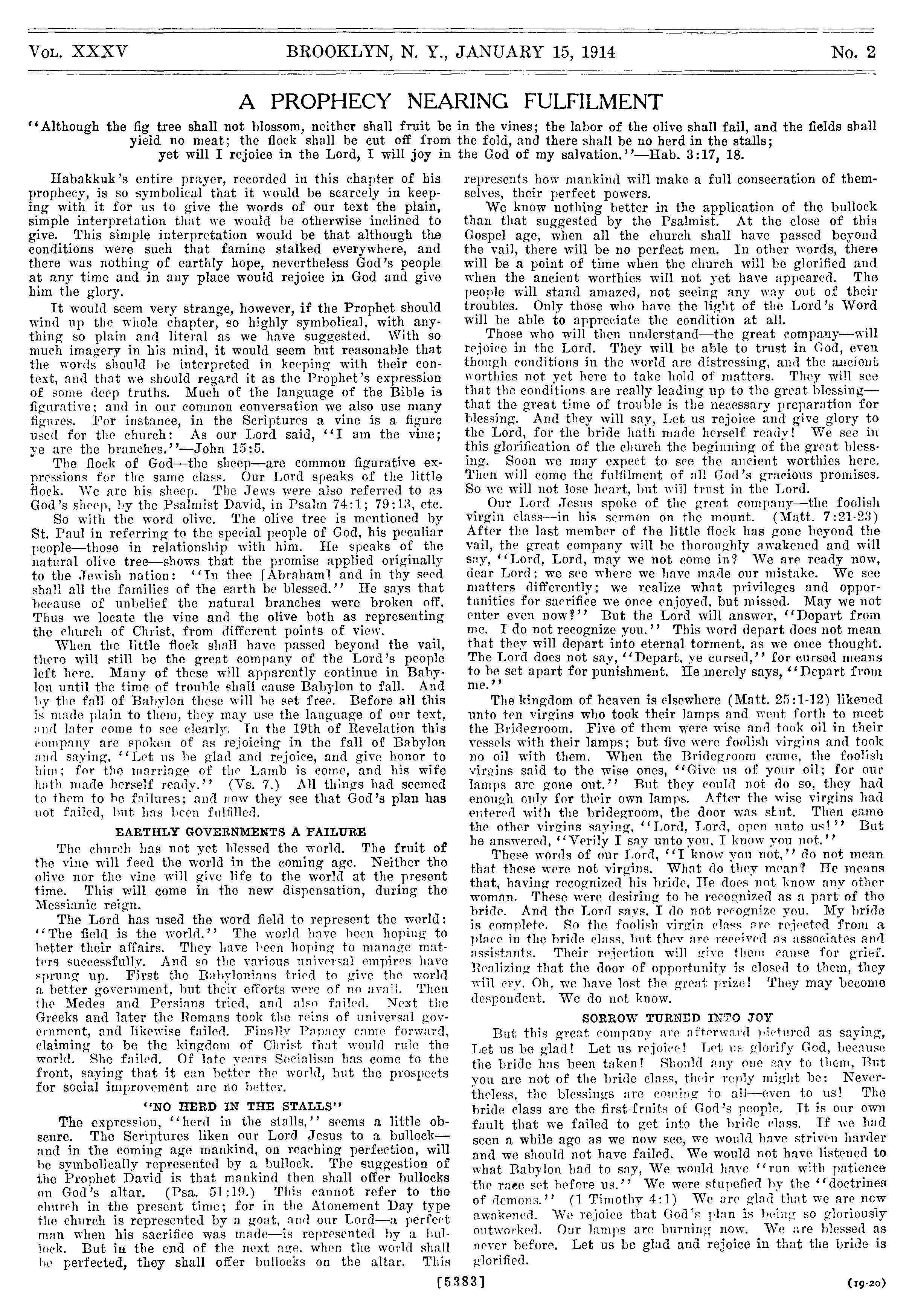
VoL. XXXV BROOKLYN, N. Y., JANUARY 15, 1914 No. 2 A PROPHECY NEARING FULFILMENT ‘¢ Although the fig tree shall not blossom, neither shal] fruit be in the vines; the labor of the olive shall fail, and the fields shall yield no meat; the flock shall be cut off from the fold, and there shall be no herd in the stalls; yet will I rejoice in the Lord, I will joy in the God of my salvation.’’—Hab. 3:17, 18. Habakkuk’s entire prayer, recorded in this chapter of his prophecy, is so symbolical that it would be scarcely in keeping with it for us to give the words of our text the plain, simple interpretation that we would be otherwise inclined to give. This simple interpretation would be that although the conditions were such that famine stalked everywhere, and there was nothing of earthly hope, nevertheless God’s people at any time and in any place would rejoice in God and give him the glory. It would seem very strange, however, if the Prophet should wind up the whole chapter, so highly symbolical, with anything so plain and literal as we have suggested. With so much imagery in his mind, it would seem but reasonable that the words should be interpreted in keeping with their context, and that we should regard it as the Prophet’s expression of some deep truths. Much of the language of the Bible is figurative; and in our common conversation we also use many figures. For instance, in the Scriptures a vine is a figure used for the chureh: As our Lord said, ‘‘I am the vine; ye are the branches.’’-John 15:5, The flock of God—the sheep—are common figurative expressions for the same class. Our Lord speaks of the little flock. We are his sheep. The Jews were also referred to as God’s sheep, by the Psalmist David, in Psalm 74:1; 79:13, ete. So with the word olive. The olive tree is mentioned by St. Paul in referring to the special people of God, his peculiar people—those in relationship with him. He speaks of the natural olive tree—shows that the promise applied originally to the Jewish nation: ‘‘In thee [Abraham] and in thy seed shall all the families of the earth be blessed.’’ He says that hecause of unbelief the natural branches were broken off. Thus we locate the vine and the olive both as representing the church of Christ, from different points of view. When the little flock shall have passed beyond the vail, there will still be the great company of the Lord’s people left here. Many of these will apparently continue in Babylon until the time of trouble shall cause Babylon to fall. And hy the fall of Babylon these will he set free. Before all this is made plain to them, they may use the language of our text, and later come to see clearly. Tn the 19th of Revelation this company are spoken of as rejoicing in the fall of Babylon and saying, ‘‘Let us he glad and rejoice, and give honor to him; for the marriage of the Lamb is come, and his wife hath made herself ready.’’ (Vs. 7.) All things had seemed to them to be failures; and now they see that God’s plan has not failed, but has been fulfilled. EARTHLY GOVERNMENTS A FAILURE The church hag not yet blessed the world. The fruit of the vine will feed the world in the coming age. Neither the olive nor the vine will give life to the world at the present time. This will come in the new dispensation, during the Messianic reign. The Lord has used the word field to represent the world: “The field is the world.’? The world have been hoping to better their affairs. They lave heen hoping to manage matters successfully, And so the various universal empires have sprung up. First the Babylonians tried to give the world a better government, but their efforts were of no avail. Then the Medes and Persians tried, and also failed. Next the Greeks and later the Romans took the reins of universal government, and likewise failed. Finally Papacy came forward, claiming to be the kingdom of Christ that would rule the world. She failed. Of late years Socialism has come to the front, saying that it can hetter the world, but the prospects for social improvement are no hetter, “NO HERD IN THE STALLS’? The oxpression, ‘‘herd in the stalls,’’? seems a little obseure. Tho Scriptures liken our Lord Jesus to a bullock— and in the coming age mankind, on reaching perfection, will be symbolically represented by a bullock. The suggestion of the Prophet David is that mankind then shall offer bullocks on God’s altar. (Psa, 51:19.) This cannot refer to the church in the present time; for in the Atonement Day type the church is represented by a goat, and our Lord—a perfect man when his sacrifice was made—is represented by a hul represents how mankind will make a full consecration of themselves, their perfect powers. We know nothing better in the application of the bullock than that suggested by the Psalmist. At the close of this Gospel age, when all the church shall have passed beyond the vail, there will be no perfect men. In other words, there will be a point of time when the church will be glorified and when the ancient worthies will not yet have appeared. The people will stand amazed, not seeing any way out of their troubles. Only those who have the light of the Lord’s Word will be able to appreciate the condition at all. Those who will then understand—the great company—will rejoice in the Lord. They will be able to trust in God, even though eonditions in the world are distressing, and the ancient worthies not yet here to take hold of matters. They will sce that the conditions are really leading up to the great blessing— that the great time of trouble is the necessary preparation for blessing. And they will say, Let us rejoice and give glory to the Lord, for the bride hath made herself ready! We see in this glorification of the church the beginning of the great blessing. Soon we may expect to see the ancient worthies here. Then will come the fulfilment of all God’s gracious promises. So we will not lose heart, but will trust in the Lord. Our Lord Jesus spoke of the great company—the foolish virgin class—in his sermon on the mount. (Matt. 7:21-23) After the last member of the little flock has gone beyond the vail, the great company will be thoroughly awakened and will say, ‘‘Lord, Lord, may we not come in? We are ready now, dear Lord; we see where we have made our mistake. We sce matters differently; we realize what privileges and opportunities for sacrifice we once enjoyed, but missed. May we not enter even now?’’ But the Lord will answer, ‘‘Depart from me. I do not recognize you.’’ This word depart does not mean that they will depart into eternal torment, as we once thought. The Lord does not say, ‘‘ Depart, ye cursed,’’ for cursed means to be set apart for punishment. He mercly says, ‘‘Depart from me, The kingdom of heaven is elsewhere (Matt. 25:1-12) likened unto ten virgins who took their lamps and went forth to meet the Bridecroom. Five of them were wise and took oil in their vessels with their lamps; but five were foolish virgins and took no oil with them. When the Bridegroom came, the foolish virgins said to the wise ones, ‘‘Give us of your oil; for our lamps are gone out.’? But they could not do so, they had enough only for their own lamps. After the wise virgins had entered with the bridegroom, the door was stut. Then came the other virgins saving, ‘‘Tord, Lord, open unto us!’? But he answered, ‘* Verily I say unto you, I know you not.’’ These words of our Lord, ‘‘I know you not,’’? do not mean that these were not virgins. What do they mean? He means that, having recognized his bride, He does not know any other woman. These were desiring to he recognized as a part of the hride. And the Lord says, I do not recognize vou. My bride is complete. So the foolish virgin class are rejeeted from a place in the bride class, but they are received as associates and assistants. Their rejection will give them cause for grief. Realizing that the door of opportunity is closed to them, they will erv. Oh, we have lost the great prize! They may become despondent. We do not know. SORROW TURNED INTO JOY But this great company are afterward pictured as saying, Tet us be glad! Let us rejoice! Let us glorify God, because the bride has been taken! Should any one say to them, But you are not of the bride class, their reply might be: Nevertheless, the blessings are coming to ali—even to us! The bride class are the first-fruits of God’s people. Tt is our own fault that we failed to get into the bride class. If we had seen a while ago as we now see, we would have striven harder and we should not have failed. We would not have listened to what Babylon had to say, We would have ‘‘run with patience the raee sct hefore us.?’? We were stupefied by the ‘‘ doctrines of demons.’’? (1 Timothy 4:1) We are glad that we are now awakened. We rejoice that God’s plan is being so gloriously outworked. Our Jamps are burning now. We are blessed as jock, But in the end of the next age, when the world shall never before. Let us be glad and rejoice in that the bride is be perfeeted, they shall offer bullocks on the altar. This glorified. (5383] (19-20)
To enhance your experience on our website, we use cookies and similar technologies. Some cookies are essential for the core functionality of our site and cannot be declined. You can choose to accept or decline additional cookies. We want to assure you that none of this data will be sold or used for marketing purposes. You can adjust your preferences at any time by accessing the Privacy Settings from the footer of the page. For more information, please refer to our
Privacy Policy
Terms of Use
.


